UGC Creator Jobs: Where They Are Actually Posted and What to Check Before You Say Yes
The four kinds of places UGC work actually gets posted, the five questions that settle an offer before the shoot, and the five signals that the answer is no.
Maria Korshak · Reading time: about 8 minutes
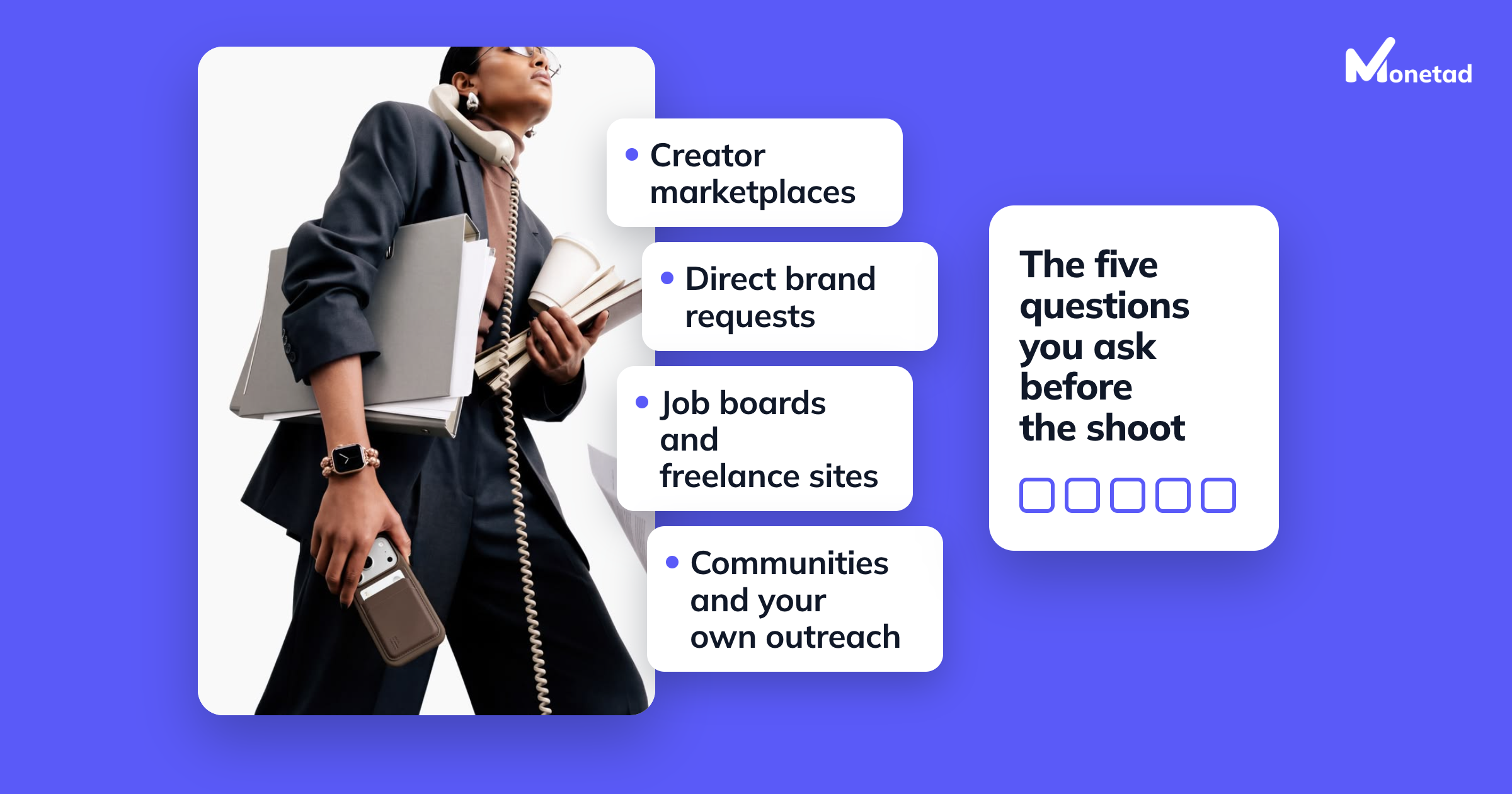
There is no shortage of UGC work, and yet the first offers a creator finds tend to look the same. Shoot a video and we will talk about payment afterwards. We will send you the product instead of a fee. Pay for access to our brand database. The problem is not that the work does not exist. The problem is that the places posting real work sit next to the places imitating it, and the listing itself rarely tells you which is which.
Below are the four kinds of places where UGC creator jobs actually get posted, and the five questions that settle an offer before you spend a shoot day on it.
What counts as a UGC job (and what doesn't)
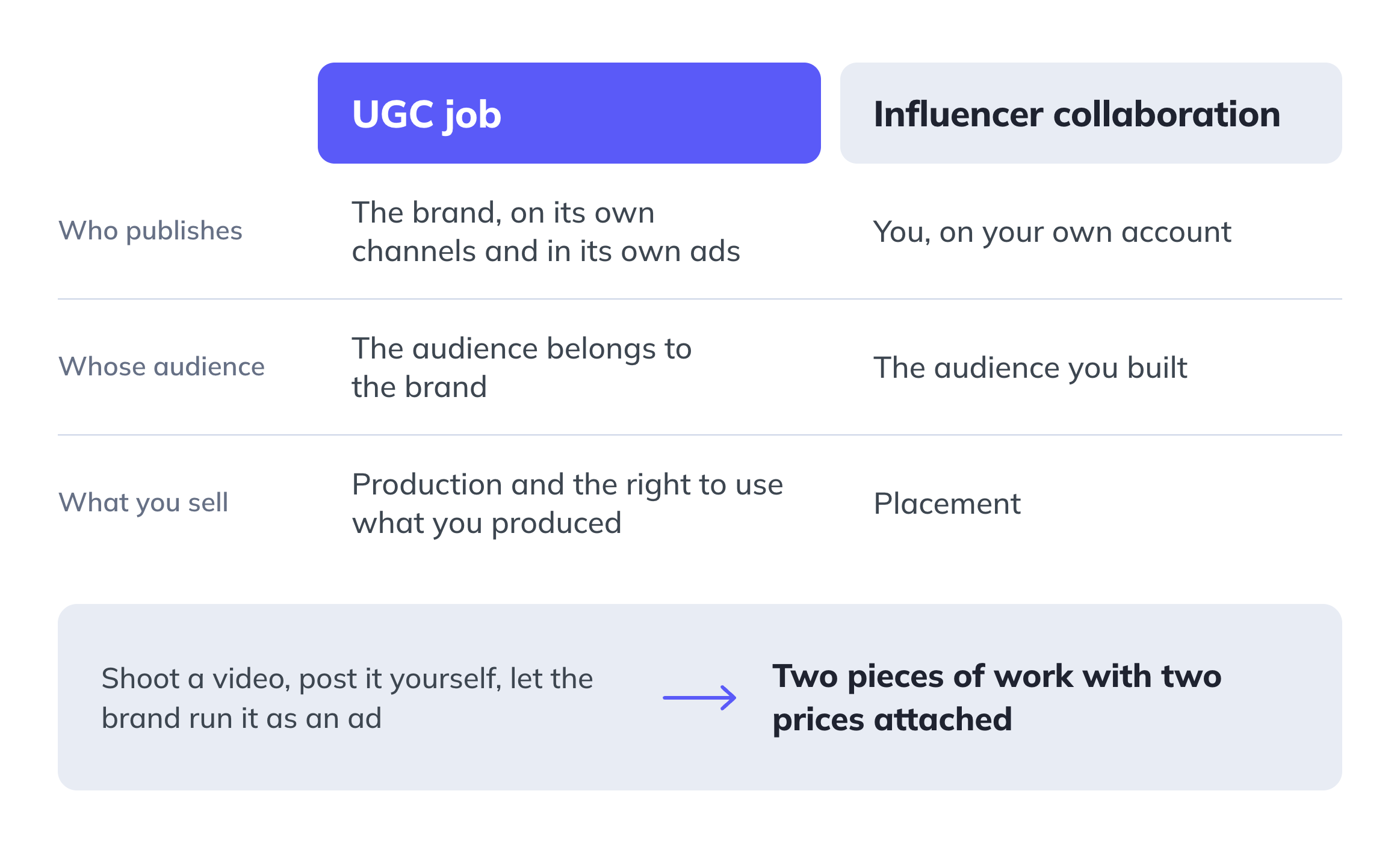
A UGC job is work where you produce content for a brand and the brand publishes it on its own channels and in its own ads. You are paid for agreed deliverables: a set number of videos or photos, in a stated format, by a stated date. The audience belongs to the brand, which is why listings for user generated content jobs and ugc content creator jobs rarely carry a follower requirement at all.
That is the line between UGC and an influencer collaboration, where you publish on your own account and sell access to the audience you built. The distinction decides what you are paid for and what you hand over. In UGC you sell production and the right to use what you produced; in a collaboration you sell placement. Usage rights come up more often on the UGC side for exactly this reason, and they are also the term most often left unsaid.
One practical consequence: a listing that blends both models, asking you to shoot a video, post it yourself and let the brand run it as an ad later, describes two pieces of work with two prices attached.
Where UGC work is actually posted
"Put yourself out there and brands will find you" is advice that never survives contact with a calendar. Work arrives from four different places, listings look different in each one, and each has its own failure mode.
| Source | What the listing looks like | How payment usually works | The thing to check first |
|---|---|---|---|
| Creator marketplaces | An offer with fixed deliverables, applications handled in-platform | Per agreed set of materials | Whether payout terms are visible before you sign up |
| Direct brand requests | A "work with us" page, a form, a post or a story | Agreed case by case, in writing or not | Who inside the brand is responsible for paying |
| Job boards and freelance sites | A vacancy or project post with a budget line | Hourly or per project | Whether the client is real and has any history |
| Communities and your own outreach | A conversation, or an email you send first | Fully negotiated | Whether anything is written down |
Creator marketplaces and UGC platforms
The mechanics here differ from cold-emailing a list of brands: a business publishes an offer, creators apply, and the business reviews the applications it receives. Your task is to match the requirements of one specific offer, which usually means niche, format, language and deadline. Persuading a stranger to open your email is not part of the process.
The thing worth checking before you upload a portfolio is whether the platform publishes its payout terms, meaning when payment happens, what the minimum threshold is and what gets deducted. A platform that answers those questions only after registration answers them at the point where walking away has already cost you something.
Brands looking for UGC creators directly
A large share of demand never reaches any listing site. Brands go looking themselves, through a "work with us" or "creator program" page, an application form, or a post or story along the lines of ugc creators needed. Searches like brands looking for ugc creators and hiring ugc creators lead to brand-owned pages and social accounts rather than to job boards.
The upside of this channel is that you are talking to the person who decides, and your price is not capped by a platform's rate card. The downside is that a small brand often has neither a process nor anyone who owns payment. So the first question here is who signs off on the terms and who pays; price is the second conversation.
Job boards and freelance sites
Traditional job boards and freelance marketplaces carry the largest volume of ugc jobs and the most noise. Wording is vague, budgets are low, and a share of the posts are resale: an intermediary takes a client brief and looks for someone cheaper to fill it.
The channel is still worth using with one rule attached: read the client before you read the post. Trading history, reviews, a registered company, a website that existed before last month. With none of that on the page, the listing is worth as much as the text it is written in.
Communities and your own outreach
The fourth source lives in conversations: creator group chats, industry communities, a recommendation from someone you have worked with, your own email to a brand whose product is already on your shelf. Those ugc creator opportunities never appear on any list, which is precisely why fewer people are competing for them.
The weak point matches the one above. The more informal the start, the higher the chance the terms stay scattered across a chat thread. A conversation can lead to a job, but the job starts where a written list of deliverables and a price appear.
What "remote" means in UGC work
Almost all of this work is remote in the plain sense: you shoot at home, deliver files, and handle the rest in writing. A search for ugc jobs remote surfaces roughly the same offers you would find without the word.
There is one qualifier. Remote does not mean location-agnostic. Some briefs ask for a specific language, local settings on camera, or everyday context an audience in that country recognizes. Treat it as a filter: it shortens your list of suitable offers and thins out the competition inside each one.
How to vet an offer before you say yes
Lists of platforms go out of date faster than criteria do. The five questions below work the same way on a marketplace offer, a job board vacancy and a DM from a brand. Ask them before the shoot, not after.
| What to check | What a sound answer looks like | What to do if there isn't one |
|---|---|---|
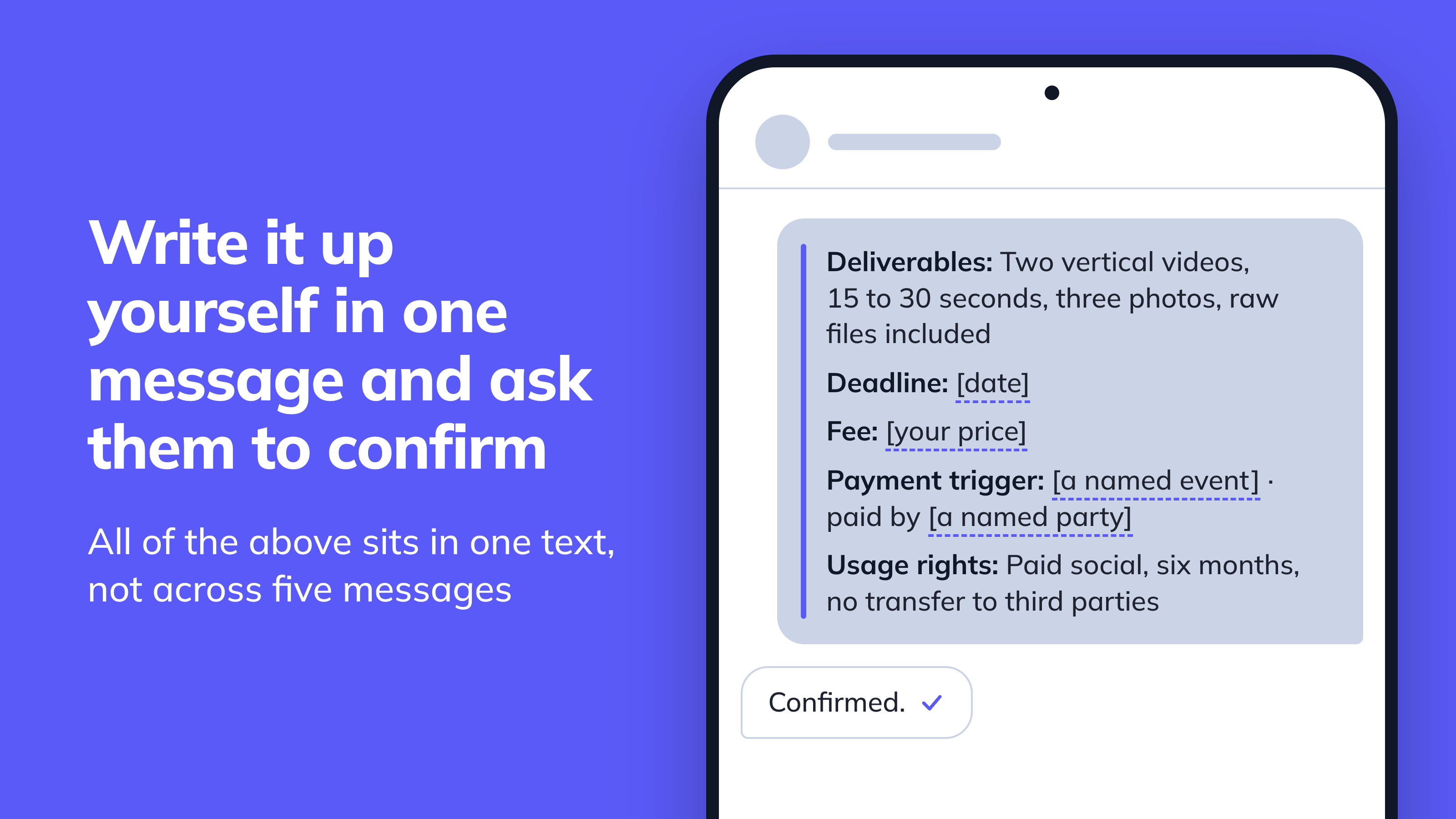
| What the deliverables are and how many | "Two vertical videos, 15 to 30 seconds, three photos, raw files included" | Do not start shooting: with no count and no format, the scope keeps growing |
| Usage rights and for how long | "Paid social, six months, no transfer to third parties" | Assume the rights were not bought, and say so before you deliver |
| Who pays and at which moment | A named event that triggers payment, and a named party who pays | Ask in writing: "we'll pay later" names neither an event nor a date |
| Whether the price is negotiable | The brand engages with a counter-proposal and explains its own number | Decide whether the work is worth the one number you were given |
| Whether it is written down | All of the above sits in one text, not across five messages | Write it up yourself in one message and ask them to confirm |
A note on price. A low first fee usually appears where the creator never named one. Being able to propose your own price when you apply is a normal part of the deal, and whether a source allows it tells you more about that source than its website design does.
If you have no experience yet
There is a correct instinct behind the ugc creator jobs no experience search: the requirements in UGC genuinely work differently. A brand wants samples in the format it needs; it is not reading a CV. Three or four self-made videos about products you actually use will answer the "show me your work" question.
What does not change is the bar set by the five questions above. If anything, the schemes described below are aimed at newcomers precisely because newcomers ask about terms less often.
Red flags
A bad offer gives itself away before any work starts. These five signals are worth a pause and a direct question; after a second evasive answer, they are worth walking away from.
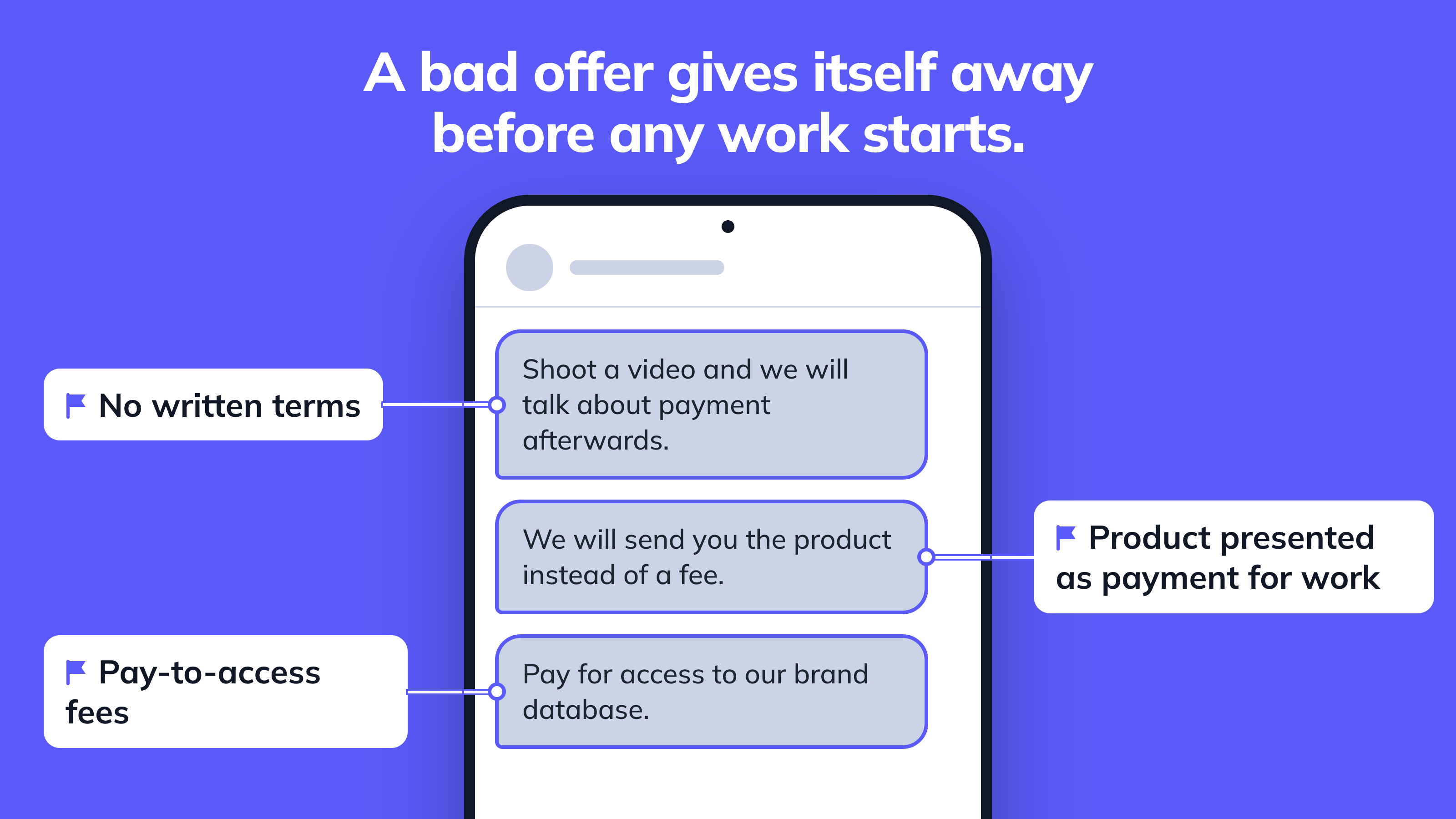
- You are asked to pay for access to jobs. A fee for "premium status", "verification" or "the brand database" is a sale of hope. In UGC, money moves toward the creator.
- A "test" task with no brief and no fee. A paid test with a clear brief is ordinary practice. A test with no brief, but with a request for the raw files, is a job someone does not plan to pay for.
- Product presented as payment for work. Barter exists and is sometimes fair, but it has to be called barter before the shoot. "Payment: an item from the new line" means a shoot day that ends without money.
- No written terms. If three messages in you still cannot see deliverables, deadline and fee in one place, there will be nothing to point at later.
- The platform hides its payout terms until you register. When payment happens and what the minimum threshold is are questions to ask before your first job, not after your first fee goes missing.
All five share a structure: an evasive answer costs you a shoot day and costs the client nothing. That is why the clarifying question belongs in your first reply. It costs nothing and it tells you immediately who you are dealing with.
FAQ
Do I need a big following to get UGC jobs?
No. The brand publishes the content, so a follower count is usually not a requirement. Format, production quality and your ability to hit the brief are what the decision rests on.
How do I price my first UGC job?
Price the work itself: the shoot, the edit, the revision round, and a separate line for usage rights if the brand plans to run the material as an ad. You name your price first. On our side that is written down as follows: Creators can propose their price on application; the brand reviews and confirms the final price in-app.
Where do brands look for UGC creators?
In the four places above, and most often in two of them at once: a marketplace or freelance site for volume, and their own channels, a "work with us" page or social account, for targeted search. Being present in both is the practical takeaway.
Do I need to sign anything for a single video?
Written terms are what matters here; a full contract for one video is uncommon. A single message listing deliverables, deadline, fee, payment trigger and usage rights, confirmed by the other side, removes most of the disputes that small jobs produce.
Before your next application
Sources change. Platforms close, boards fill up with spam, brands move recruiting to a different channel. The five questions you ask before the shoot do not change. An offer that answers them is worth your day; an offer that dodges them will not improve after you hand over the files.
This article is published by Monetad, and two of the conditions above are how we work ourselves: Creators can propose their price on application; the brand reviews and confirms the final price in-app. Creators receive payment after the work is approved. That is the same standard worth holding every source of work to, including us. And here is where we are on our own side: Campaigns opening for early creators. Bring the five questions with you when you apply.