Black Friday Collabs You Should Turn Down
Five signals an offer is not worth taking, the last date you can still say yes, and the five lines that settle the rest.
Maria Korshak · Reading time: about 9 minutes
The fourth offer arrives on a Wednesday evening, while two earlier ones are still in revisions and the third — taken a week ago — has a posting date you can no longer recall. In August, when the season's offers first start landing, that is survivable; it stops being survivable in November, because there are more offers and less time for each one. We read seven brand-side plans for the season, then counted them back from the creator's side. The rule that came out of it is simple: you can take as many collabs as you can name deadlines for, and no amount of incoming offers raises that number.
The rest is a calendar and a method. You'll find the three dates the season runs on, the last date to take new work for it, five lines that settle a collab before you say yes, and five signals that the answer is no.
When Black Friday offers actually arrive
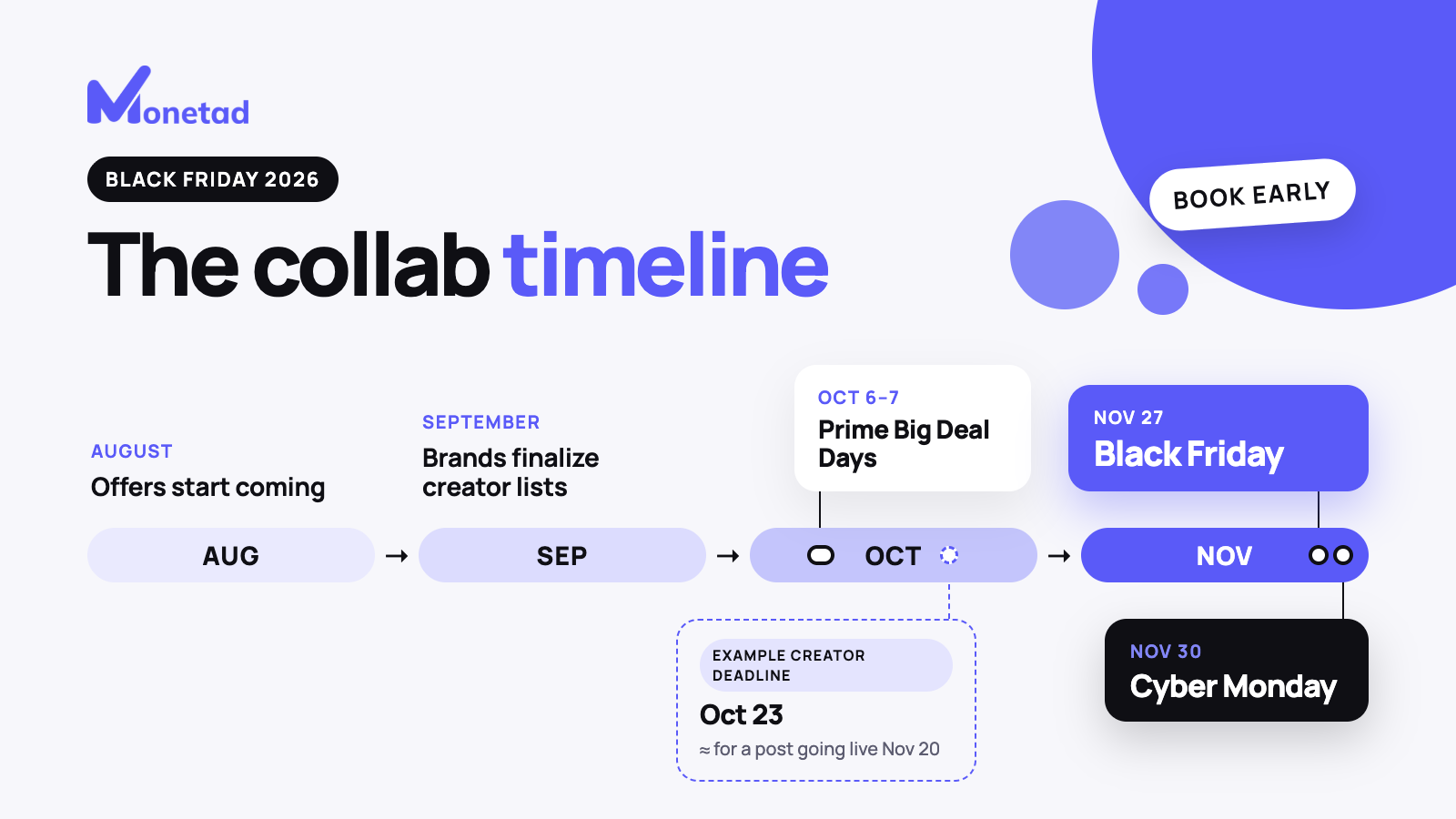
Three dates hold the 2026 season together. Amazon's Prime Big Deal Days fall on October 6–7, Black Friday lands on November 27, and Cyber Monday on November 30. Brands work backward from all three months ahead, because a lineup assembled in October leaves nothing to produce with.
Modash's guide to recruiting creators for the season, published March 12, 2026, tells brands to have their lineup settled by September, and StackInfluence's 90-day plan, published August 23, 2026, and updated September 1, puts the conversion waves in November 16–30.
The creator reads the same calendar from the other end: offers arrive in August and September, so the production window is narrowing exactly as the number of offers grows.
The last date you can still take a Black Friday collab
Work backward from the posting date. Four weeks is a reasonable default for the shoot, two revision rounds and the brand's sign-off, so a post going up on November 20 has to be agreed by October 23. The four weeks are a placeholder, because the number to use is the one from your last collab.
October 6–7 pulls the line into September, and that is why anything aimed at Prime Big Deal Days had to be agreed in early September, when brands were closing their lineups.
The date has one job. It tells you which offers to stop reading, and it does not tell you to refuse them. An offer arriving on November 10 for a November 27 post is filling someone else's gap, so the terms decide whether you take it.
What breaks first when two collabs overlap in November
Filming is not what breaks, because it is the one stage that sits in a calendar and can be seen coming.
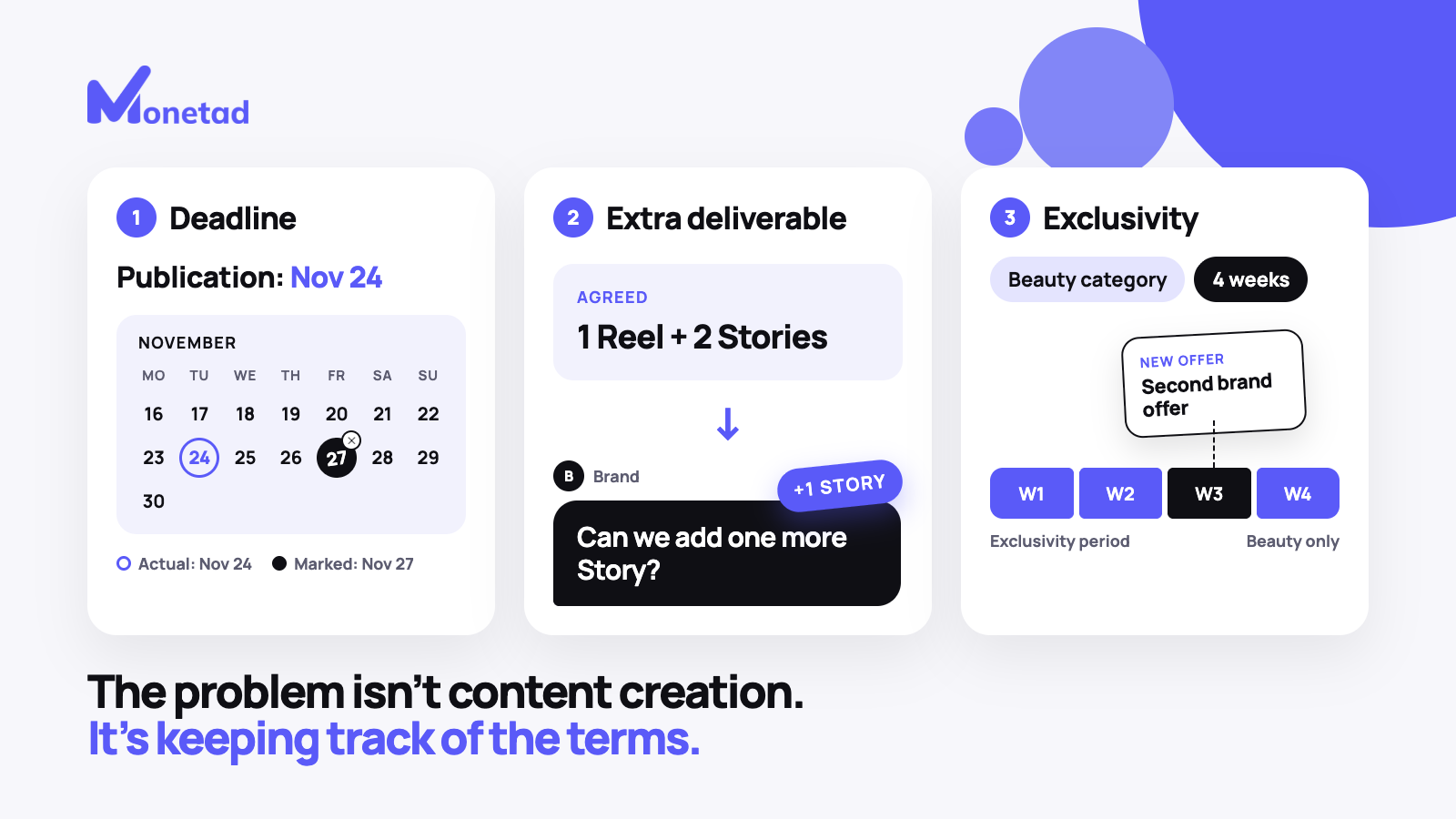
The terms break. Here is a made-up but ordinary November week. You remembered the deadline as "the week of Black Friday" while the email said the 24th. A second Story turned up in a voice note between two working days, so it never made it onto a list. The exclusivity window in the first offer closed your category for four weeks, and the second collab landed inside it.
All three losses have one thing in common: the detail exists in one chat and on no list, and a detail like that lives until the next working day.
Each loss has its own price. A moved date costs a production day, an extra Story costs unpaid work, and a broken exclusivity window costs a second collab you had to decline. In November there is no spare week to absorb any of the three.
How many collabs you can keep moving at once
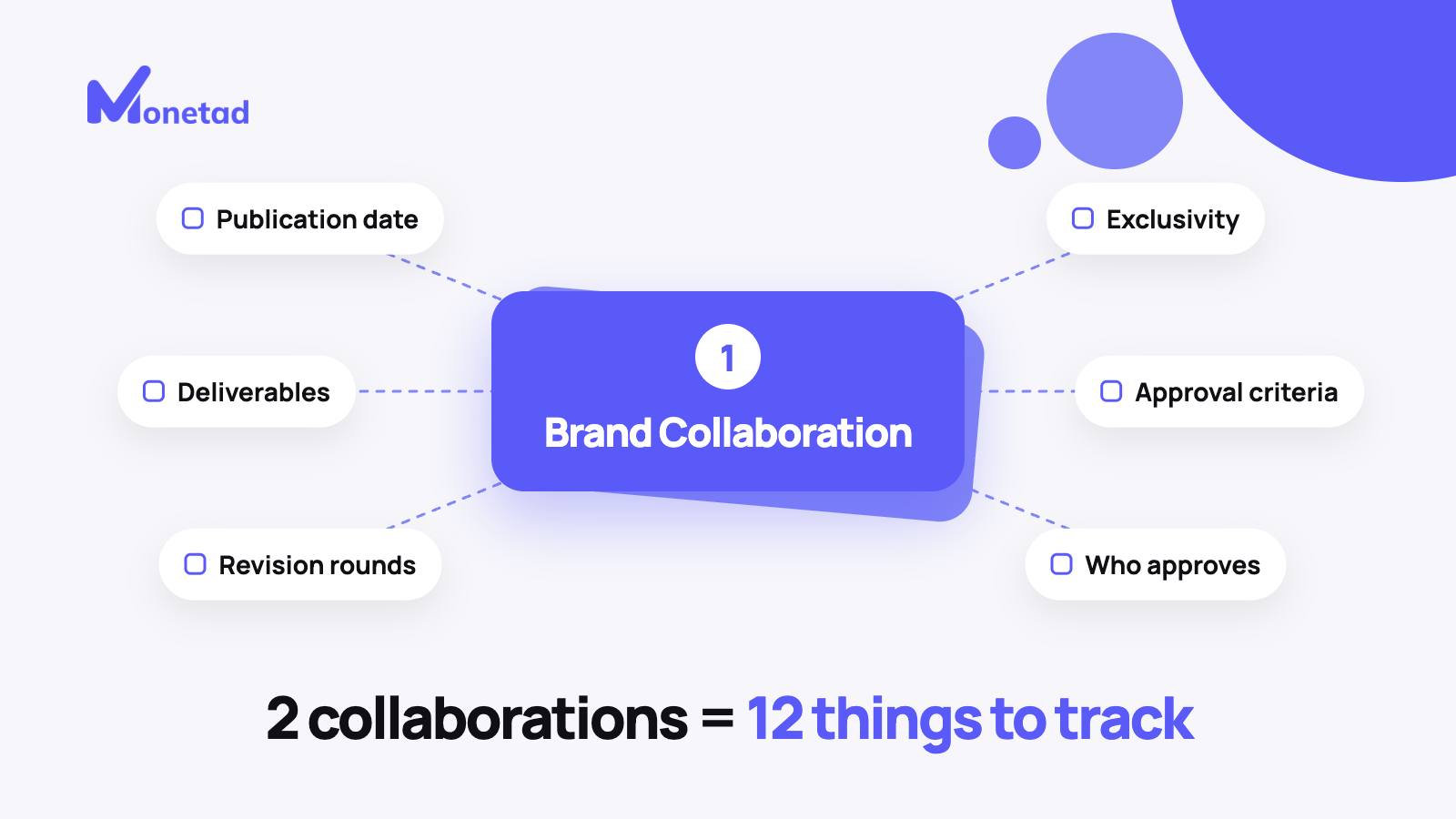
Every creator has a ceiling, and it is measured not in brands or editing hours but in the terms you have to keep in your head. One collab comes with six of them: the posting date, what exactly you deliver and how many, the number of revision rounds, the exclusivity window, what counts as the work being approved, and who approves it. Two collabs mean twelve, and it grows from there. The arithmetic is an illustration, but the six are worth recounting against your last collab — and two of them probably live nowhere except a chat thread.
You can test yourself in a minute. Take every collab that is running right now and name, from memory and with no chat open, the posting date and the number of revision rounds. The count you reach is the count you carry, and it is the count you take into the season even if you agreed to more. If it comes out lower than the number of collabs you accepted, the problem is not discipline: the terms are somewhere you cannot see them, which is why they do not come to mind. Two collabs with their terms written down run more calmly than four whose terms have scattered across DMs, email and two cloud folders.
One more condition hides in the thread. When two people from the brand write to you, the change request can come from one and the approval from the other, and nothing in the signature tells you which is which. Only one of them has the yes that counts.
Five lines to pin down before you say yes to a Black Friday collab
All five are questions for the brand, and they go out as one message in the thread where the deadline was discussed, because a question asked in a new channel starts a conversation nobody finishes.
The number is not arbitrary. Each of the five changes either money or a date, and on a season deadline there is no second pass to fix either. Asking now costs one message; asking in November costs a week you do not have, and no lawyer is involved either way.
| What to pin down | What it costs if you skip it | The message to send |
|---|---|---|
| The posting date: the calendar date, in writing | The date moves in someone else's favor, and in November there is no room to move it back | "Confirming the posting date: November 24, correct?" |
| The list of deliverables: what exactly, and how many | "One more Story" turns up with no deadline and no price | "My count is one Reel and two Stories. Anything else?" |
| The exclusivity window: how long, which category, which countries | A second season offer in the same category has to be declined after you said yes to the first | "Is there exclusivity on this? For how long, and in which category?" |
| How scope changes: what happens when the work grows and the deadline does not | The extra work gets done for free, on the original deadline | "If a post is added, do we agree a new deadline and price before that work starts?" |
| The payment order: what counts as approved work, and who approves it | You wait for payment without knowing what you are waiting on | "What counts as the work being approved, and who signs off on it?" |
When to turn a collab down — and how to say it
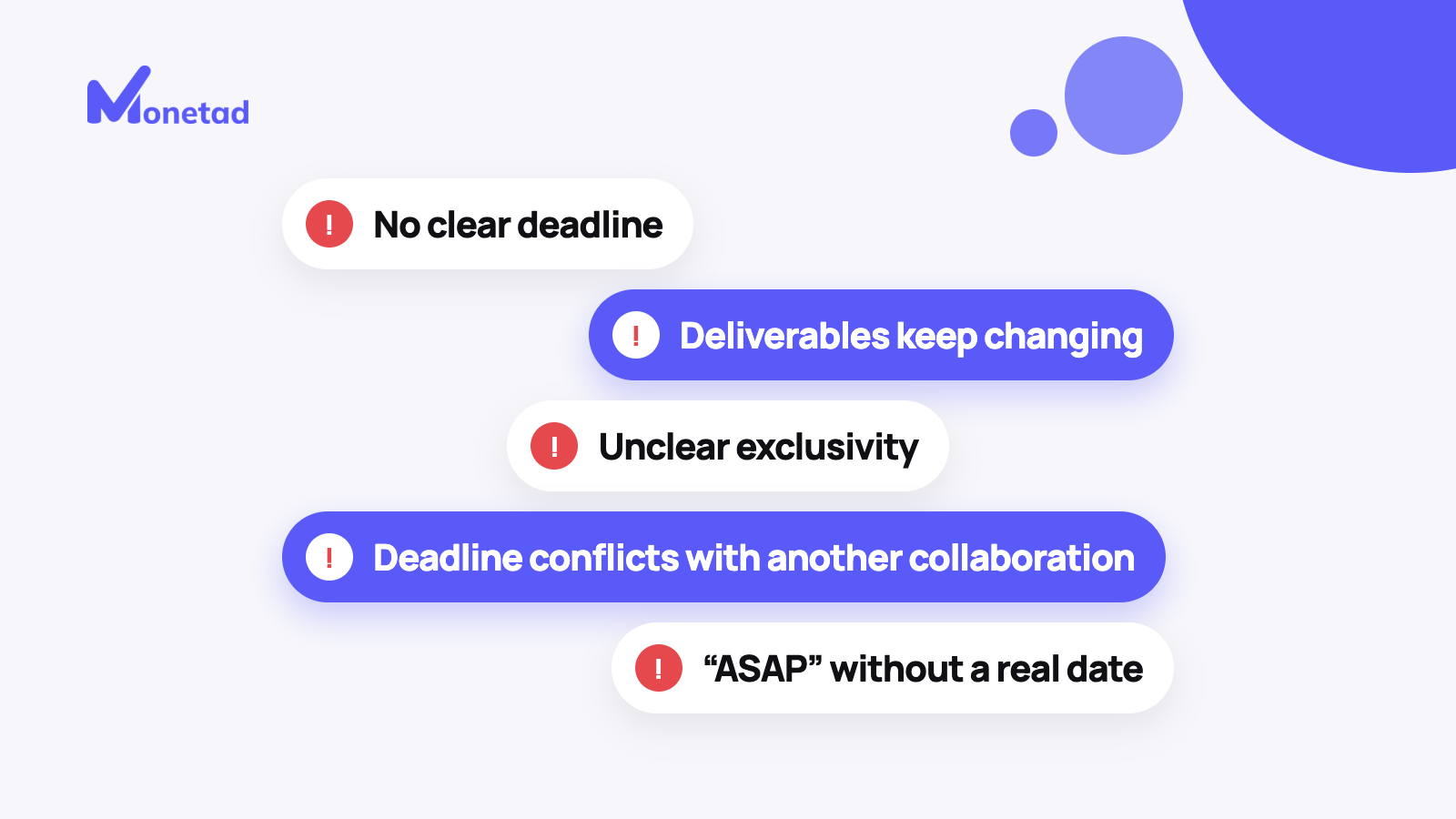
Five signals say a collab is not worth taking, and each is in the text of the offer, which means all five are readable before you answer.
- You cannot name the deadline after reading the offer twice.
- The list of deliverables changed between the first message and the second.
- Exclusivity is mentioned with no length and no category.
- The posting date falls inside another collab's revision window.
- The offer names Black Friday but no calendar date, and the brief says the content was needed yesterday.
Turning something down is part of the work. It takes three lines: what you are not taking, one reason, and the date you are free again. The brand stays in reach, because a named date is something a planner can still work with.
"Thanks for the offer. I can't hold that deadline — another post is already on the same week. I'm open from December 8, and if the dates can move, let me know."
A named date turns a refusal into a reschedule, and if the brand's plan has any give, the next window is often January.
Take the most recent Black Friday offer in your inbox and run the same five lines against it. One message, today.
Where the five lines live once you've said yes
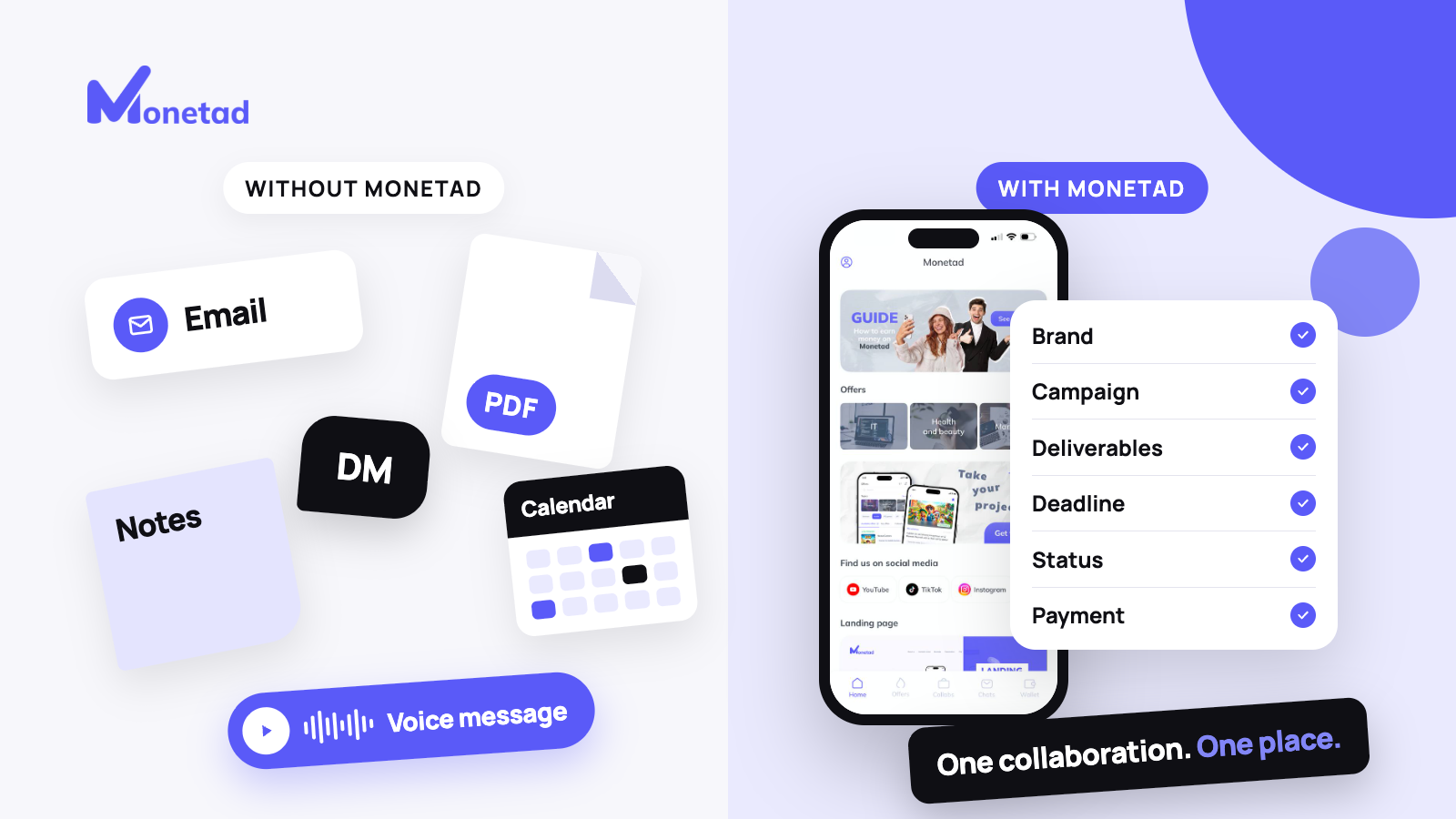
The five lines go out as one message. The answers come back one at a time, and that is where they start to scatter. An answer arriving on its own gets filed wherever you happened to be reading it. Three of the answers land in three places: the posting date in email, the extra Story in a voice note, the exclusivity window in a PDF you opened once. By November there are more of these threads than in September, and less time to read them.
Nothing here depends on how organized you are. A note or a screenshot is not attached to the collab it belongs to, so the terms have to be found before they can be read. And if finding them takes longer than answering, you answer without them. The five refusal signals have the same problem from the other side. You can only read a new offer against work you already took if its terms are still at hand.
Monetad is an iPhone app for creators, and this article comes out of building it. Your collab, its terms and its status stay in one place. Creators receive payment after the work is approved.
Before you answer the next offer
The next offer will land with its own date and its own list. The five lines that settle it are the ones you already have, so the only thing that changes is how fast you can answer them.
One thing sits outside those five lines: if the brand doesn't approve the work, you can raise it with us and a person looks at it. Download the iOS app.
What else creators ask about Black Friday collabs
Is there a number of Black Friday collabs that counts as too many?
There is no single number. The working limit is how many posting dates and revision counts you can name from memory, and anything above that is carried on luck.
How do you get Black Friday collabs as a creator?
Ask before the lineup closes. Brands are told to have their season roster settled by September, so a pitch sent in August lands while the plan is still being written.
Where do creators find collabs for the season?
Three routes cover most of it: a brand's own creator page, lists run by platforms and agencies, and your DMs. Which route found you matters less than whether the five lines are written down.
Does an exclusivity window stop you working with anyone else?
Only inside what the offer names. The period, the category and the countries; if none of the three is written down, exclusivity has not been agreed, and that is the question to send before you say yes.
A brand needs the content in three days. Is that a reason to skip the terms?
It is the reason to write them down. A three-day turnaround leaves nothing to correct afterward, so the scope and the date have to be agreed before the work starts.
How we checked this. The 2026 dates for Black Friday and Cyber Monday are calendar dates: November 27 and November 30. Prime Big Deal Days are October 6–7, 2026. The September lineup practice and the November 16–30 conversion waves come from Modash's guide of March 12, 2026 and StackInfluence's 90-day plan of August 23, 2026. On September 25, 2026, we went through seven brand-side publications about the season, and in none of them was the creator the main reader. The four-week production allowance is a working default, and October 23 is what that default produces on a November 20 posting date. Neither number is measured. The November week, the three lost details, the six conditions and the wording in the table are illustrations written for this article; they don't come from data.