What Is a UGC Creator? The Role, the Pay and How to Become One
Maria Korshak · Reading time: about 11 minutes
We decided to look into what brands buy when they pay someone for UGC. A UGC creator makes photos and videos that a brand posts on its own channels and runs as ads. You get paid for the content and for the brand's right to use it. Your samples do most of the convincing.
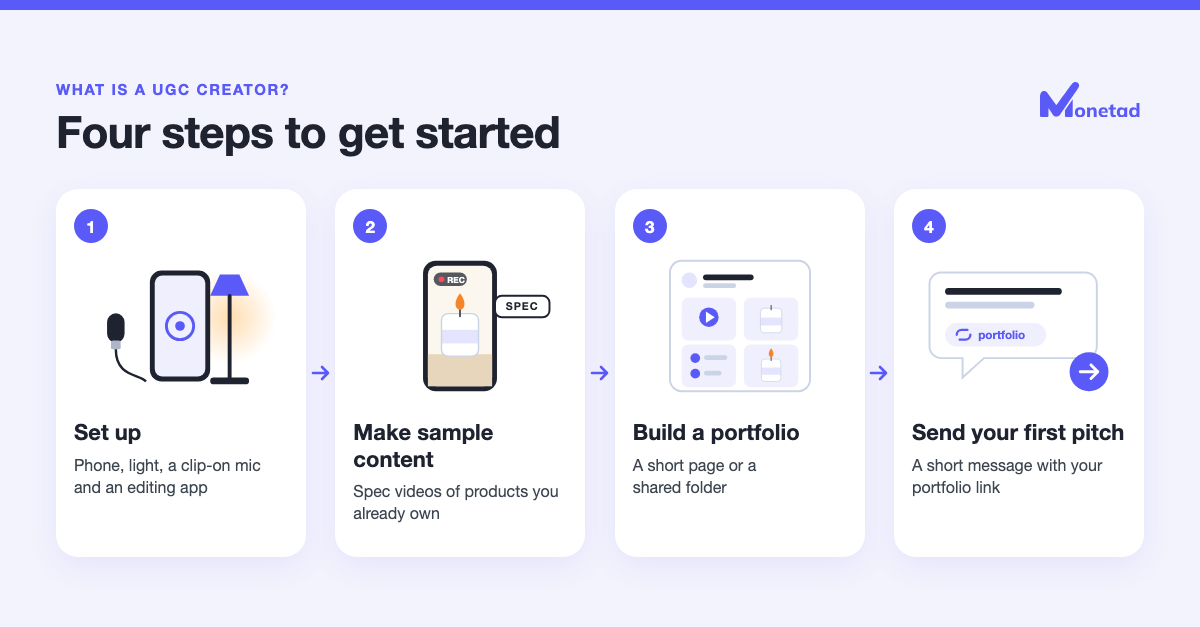
If you're deciding whether to try this work and don't have clients or a big audience yet, this guide gives you four steps to get started and three ways the work gets paid.
What is a UGC creator?
UGC stands for user-generated content, meaning material that looks and sounds as if a customer made it. A user-generated content creator is the person who makes it on purpose and gets paid for it. The brand decides where it goes: its Instagram or TikTok account, its product pages, its emails or a paid ad. Your own account may never be involved. In practice the work runs like a small production job: a UGC content creator gets a brief, shoots what it asks for, hands over the files and grants the brand the right to use them on agreed channels for an agreed period. Some creators also post the result on their own accounts, which is a separate piece of work with its own terms.
How UGC work differs from influencer work
If a brand posts your video on its own account, that's UGC work, and if you post it on yours, that's an influencer collab. The brand pays for different things in each. In an influencer collaboration, the creator publishes on their own account and the brand pays for access to the audience behind it. In UGC work, the brand publishes the content itself and pays for the material plus the right to use it.
| UGC work | Influencer collaboration | |
|---|---|---|
| Where the content lives | The brand's accounts, website and ads | The creator's own feed |
| Who publishes it | The brand | The creator |
| What the brand pays for | The material and the right to use it | Access to the creator's audience |
| Whether follower count matters | Rarely; samples carry the decision | Yes, it's part of what the brand buys |
| What the brand receives | Files plus usage rights | A post on the creator's account |
A brand buying UGC shows the video to its own audience, so the number of people following you doesn't change how many people see it, and the brand decides on the strength of your samples. Your portfolio does the job a follower count does in influencer marketing. A small account is rarely a barrier here. If a collab also includes a post on your own feed, a small following can work in your favor. The smaller the audience, the more it trusts a sponsored post. Building your own audience is a separate route with different economics, and the guide on turning a small audience into paid offers covers it from scratch.
What the work looks like: formats brands ask for
Briefs vary by brand, but these formats come up again and again, and you can practice each one before anyone hires you:
- Unboxing. Opening the package on camera, first reaction included.
- Review or testimonial. Your take on the product after using it.
- Tutorial or demo. How the product works, step by step.
- Before and after. The same scene before and after the product is used.
- Lifestyle clip. The product as part of an ordinary day, with no sales pitch.
- Product photos. Stills in a real setting, for listings, ads and emails.
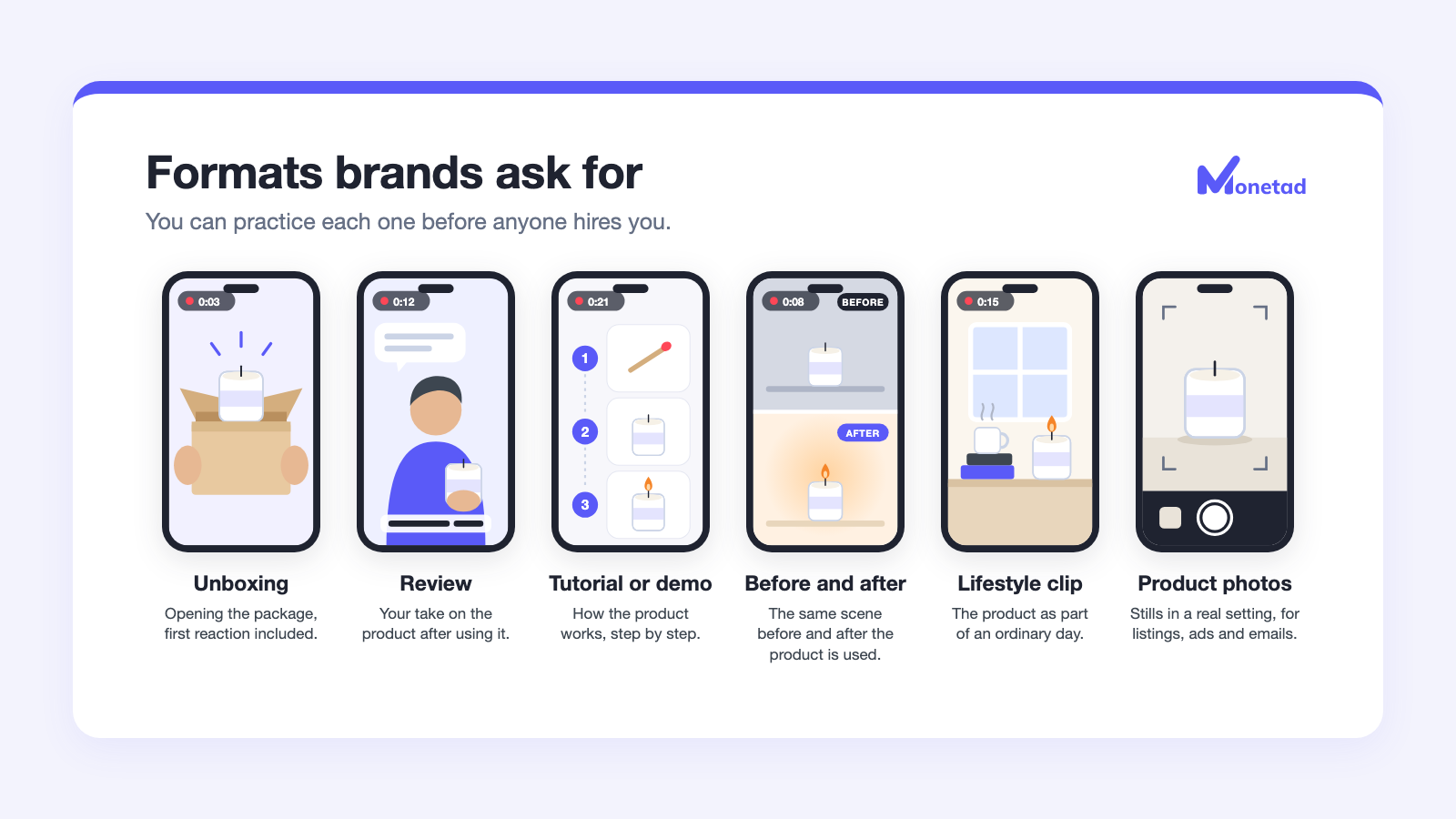
Short vertical video is the format to practice first, and a brief may ask for several opening hooks on the same footage so the brand can test which first line keeps people watching.
Why brands pay for UGC instead of shooting it themselves
Brands hire UGC creators for three reasons: a customer-made look, the number of versions that ad testing needs, and speed. Polished studio footage looks like an ad, while a video filmed on a phone in someone's kitchen reads as a recommendation from a person who used the product. In IAB's Insight Engine study "The Creator Signal," cited in IAB's 2026 CreatorFronts recap, everyday consumers were the most trusted creator type, at 52%, followed by professional reviewers at 43% and subject-matter experts at 37%. The study measured trust in types of creators. It didn't measure how UGC ads perform, and everyday consumers in the study aren't the same as paid UGC creators.
Volume is the second reason. A brand running paid social ads needs many versions of the same message, with different faces and opening hooks, to find out which one people respond to, and ordering those versions from several creators spares the brand a shoot for each. Speed is the third: a creator can turn a brief around from home, and the brand can swap out a version that stops working, without a new shoot.
Is it too late to start?
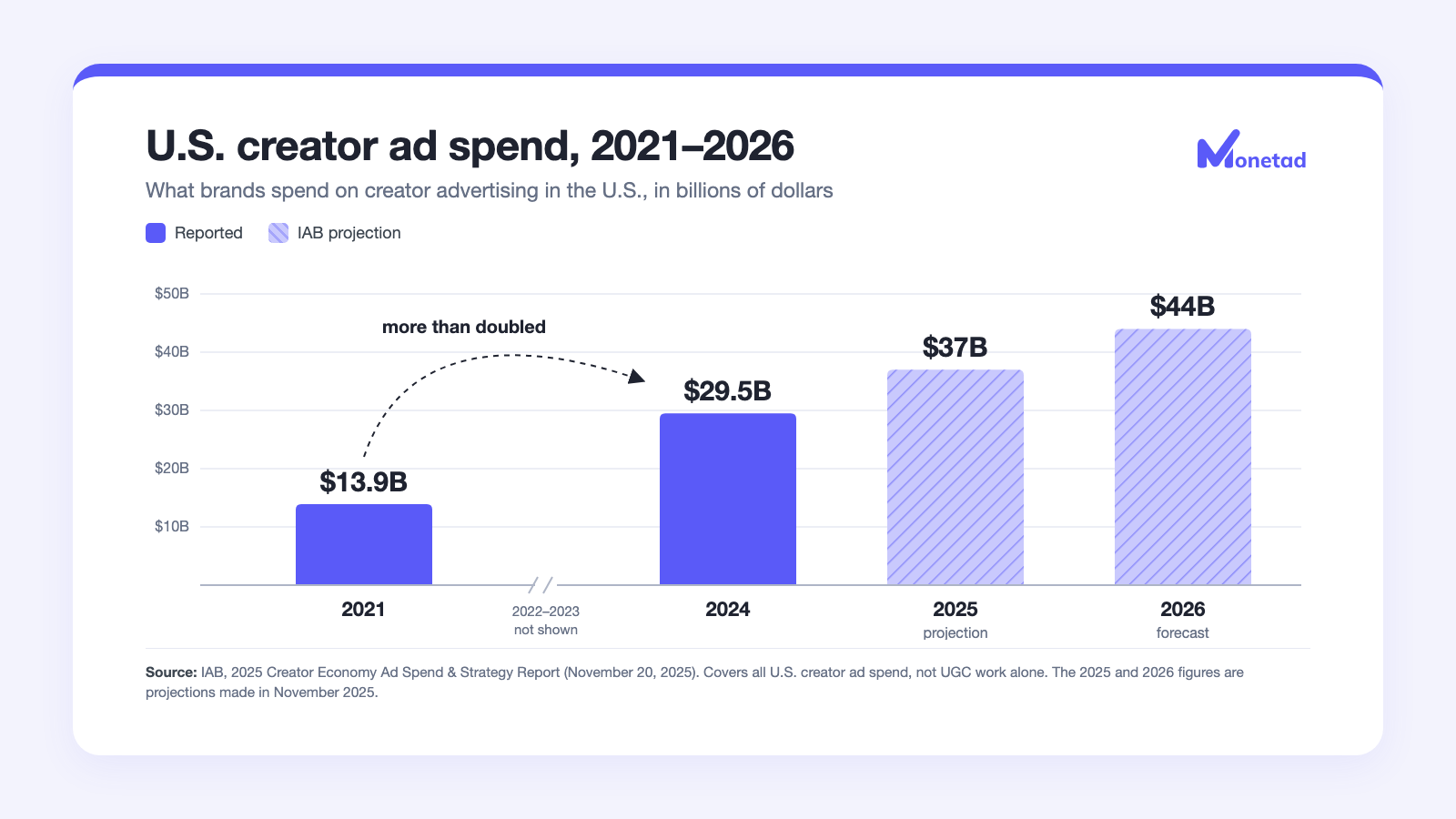
The clearest public data is about brand spending: IAB's figures show U.S. creator ad spend more than doubling from 2021 to 2024, with more projected for 2025 and 2026. IAB's 2025 Creator Economy Ad Spend & Strategy Report, published on November 20, 2025, put U.S. creator ad spend at $13.9 billion in 2021 and $29.5 billion in 2024. For 2025, the report projected $37 billion, up 26% year over year. IAB's forecast for 2026 was $44 billion. So the $37 billion projected for 2025 is roughly 2.7 times 2021's $13.9 billion, and the $44 billion forecast for 2026 is about 19% above the 2025 projection.
The buyer side looks similar. IAB's 2025 report says 48% of creator ad buyers considered creators a "must buy." IAB's Outlook update of September 10, 2026, found that creator and influencer advertising and partnerships was the ad type receiving "the most increased focus." IAB lists it first, at 54%.
IAB measures U.S. ad spend on creators overall and doesn't report UGC work separately, and its 2025 and 2026 figures are projections. Both were made in November 2025. We couldn't find a primary-source count of creators more recent than 2022, so we can't say how crowded the field is now.
How to become a UGC creator
Getting started as a UGC creator takes four steps in a fixed order: set up, make sample content, build a portfolio and pitch.
What you need to start
You don't need much gear: a recent phone, daylight from a window or a cheap lamp, a clip-on microphone and a basic editing app. Prioritize sound. Muffled audio is hard to fix in editing, while dim footage can often be brightened. Beyond the gear, you need a few skills, starting with writing a hook, meaning the opening line or image that gives a viewer a reason to keep watching. You also have to follow a brief closely, since a brand that asked for a demo has no use for a lifestyle clip, however good it looks. Being comfortable on camera matters too, though you can shoot hands-only footage if you'd rather not show your face.
Building a portfolio before any brand hires you
A UGC creator portfolio is a short page or a shared folder that shows a brand what your work looks like. You build the portfolio before the first paid brief by making spec content: photos and videos of products you already own, made as if a brand had ordered them. Label each piece as spec work. The label tells a brand the piece was made for practice, so no one mistakes it for work done for a client.
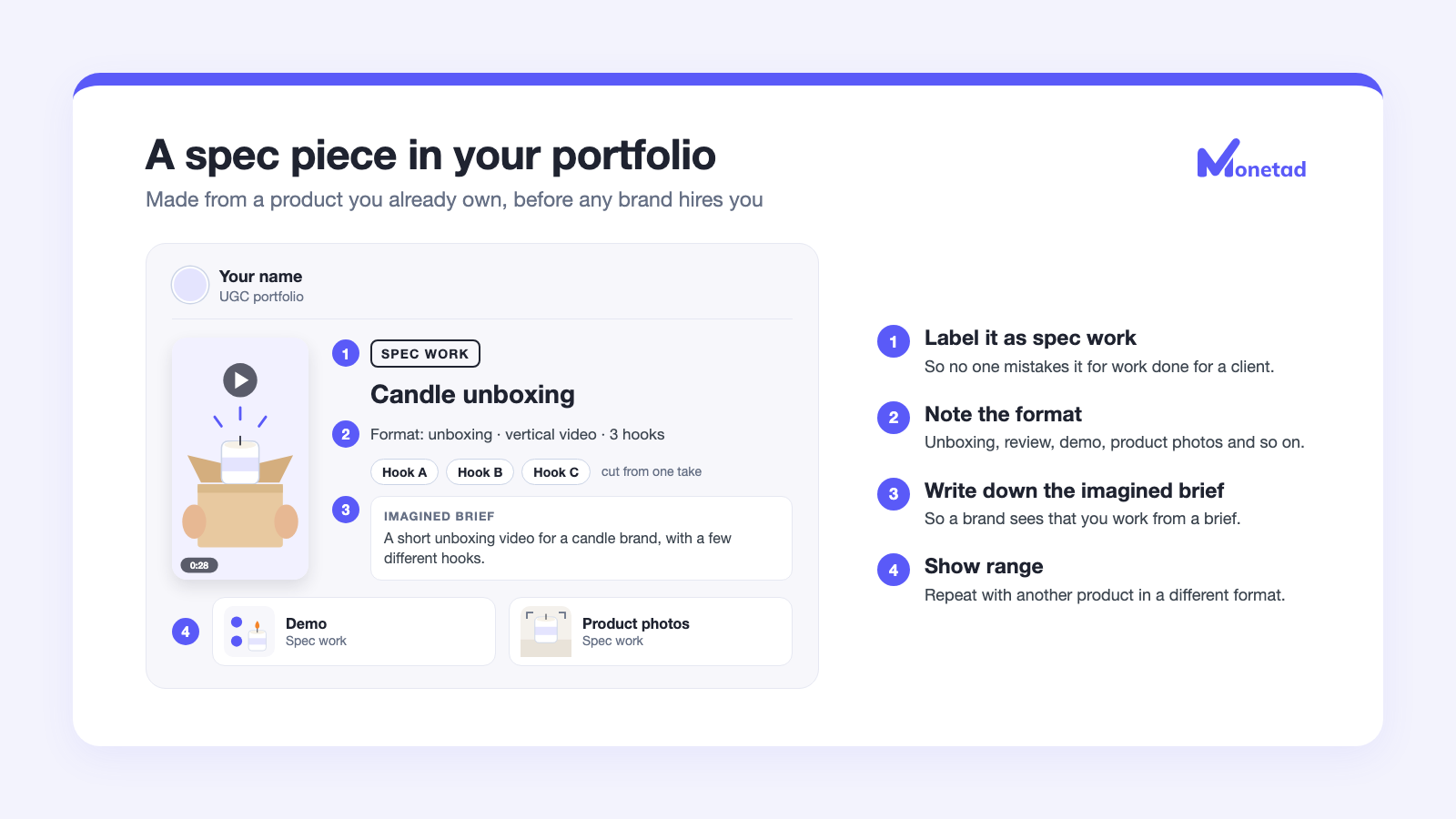
Here's a made-up brief to practice with: a short unboxing video for a candle brand that asks for a few different hooks. Write the brief down before you film. Cut every version from one take, then repeat the exercise with another product in a different format, such as a demo or a set of product photos, until the portfolio shows range.
Next to each piece, note the format and what the imagined brief asked for, so a brand reading the page sees that you work from a brief.
Your first pitch
The fourth step is a short message to a brand whose product you've used, with a link to your portfolio and the one sample closest to that brand's category. Pitching a brand directly is one way UGC creators find work. Brand creator programs are another. They run on the brands' own pages, and if a program has you post on your own account, that makes it an influencer collaboration. The pitch needs a sample to point to, so make your first spec video this week.
How UGC creators get paid
UGC work is paid in one of three ways: a flat payment per piece, payment for the content plus usage rights, or payment in product. A single collab can use more than one model. There's no standard rate. You can still control what each model covers and what you agree on in writing before filming.
| Model | What is paid for | When it fits | What to settle before filming |
|---|---|---|---|
| Flat payment per piece | Each video or photo set delivered to the brief | Content for the brand's own organic accounts | Number of pieces, hooks per video and revision rounds |
| Content plus usage rights | The material, plus a separate line for paid ads or longer use | The brand plans to run the content as ads | Channels, paid ads or organic only, and the term |
| Payment in product | The product itself, in place of money | Early portfolio pieces, for a product you'd use anyway | Where the brand may use the content, and for how long |
Product-only collabs need one more check: under the FTC Endorsement Guides, as of October 13, 2026, material connections can include free or discounted products as well as monetary payment, so a collab paid in product can still involve a connection to disclose.
Whatever the model, agree on when you get paid, in writing and before you film: one option is a deposit upfront and the rest on delivery, and another is payment once the brand accepts the files.
Usage rights: why they change the price
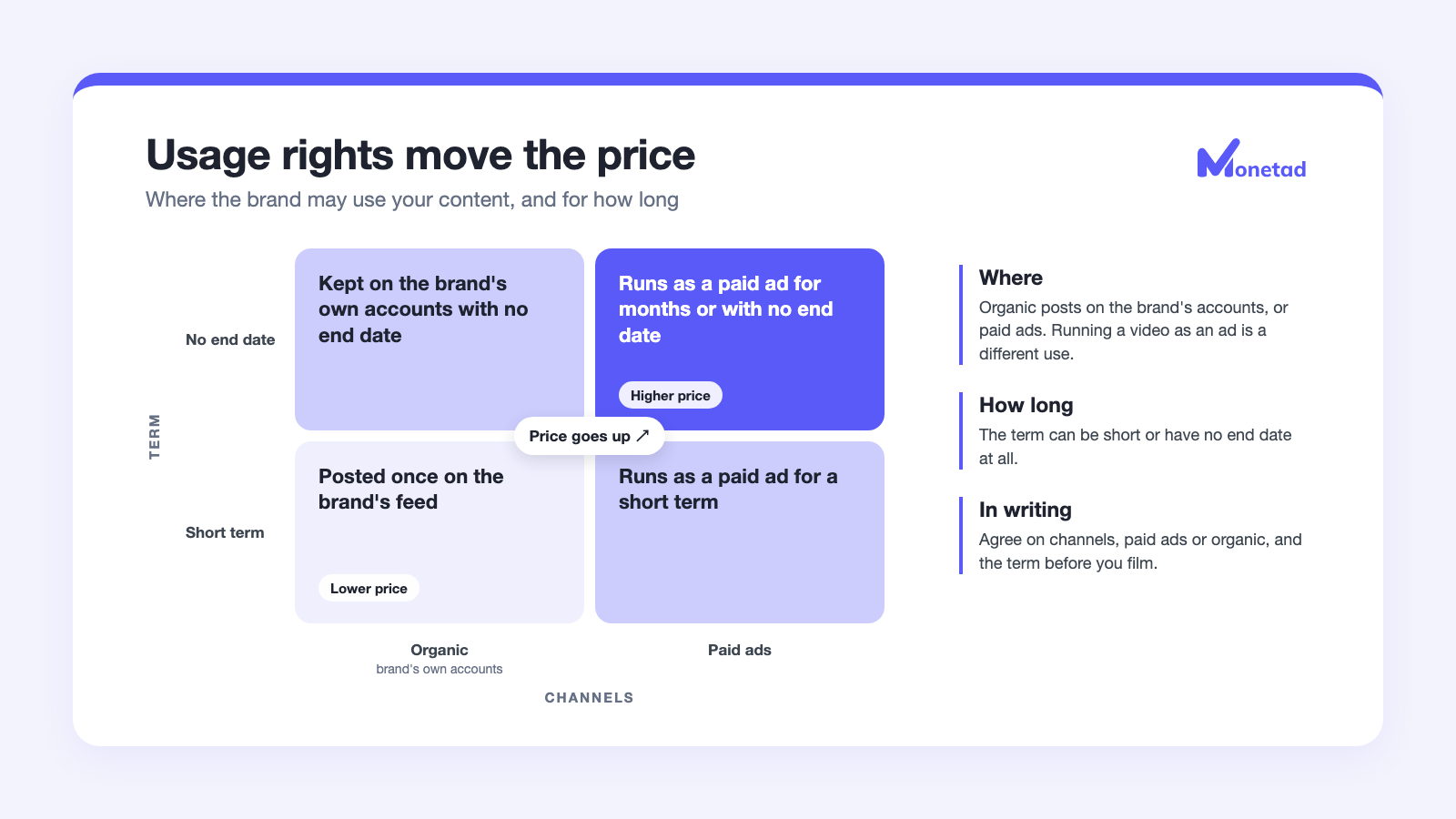
Usage rights define where the brand may use your content and for how long. The price moves with both. Running your video as an ad is a different use than posting it organically, and the term can be short or have no end date at all. A video that runs as a paid ad for months does more work for the brand than the same video posted once on its feed, and the price should reflect that. Rights are only one factor, and what goes into the price of a creator collab walks through the others.
Before you film: what to get in writing
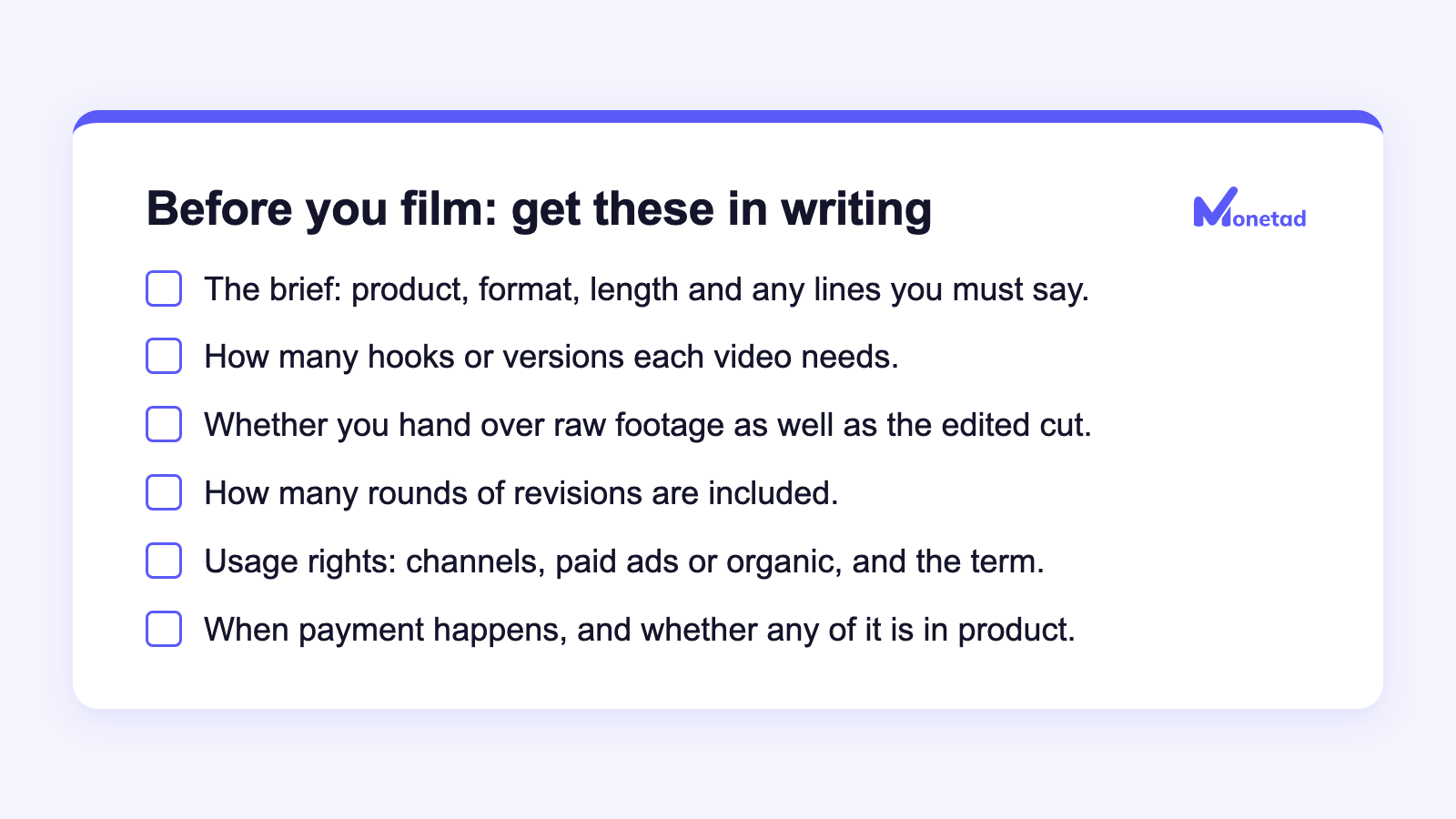
Details scattered across a chat thread get lost by the time the files are due, so write these down before the shoot:
- The brief: product, format, length and any lines you must say.
- How many hooks or versions each video needs.
- Whether you hand over raw footage as well as the edited cut.
- How many rounds of revisions are included.
- Usage rights: channels, paid ads or organic, and the term.
- When payment happens, and whether any of it is in product.
Disclosure: what the FTC guides say
If a brand pays you or sends you a free product, that can be a material connection under the FTC's Endorsement Guides, as they appeared on eCFR on October 13, 2026. That connection can trigger disclosure. It does when your audience wouldn't reasonably expect the connection and it might materially affect how much weight or credibility your endorsement carries. Under 16 CFR 255.5, material connections that must be disclosed can include a business, family, or personal relationship. They can also include monetary payment or free or discounted products.
On how to disclose, 16 CFR 255.0(f) says that on social media or the internet the disclosure should be unavoidable. For a video, say it and show it. Under 16 CFR 255.0(f), a disclosure shown and spoken at the same time is more likely to count as clear and conspicuous.
A separate FTC rule covers consumer reviews and testimonials. Under 16 CFR 465.2(a)(1), published in the Federal Register on August 22, 2024, and in effect since October 21, 2024, it is unfair or deceptive for a business to write, create, or sell a review or testimonial that materially misrepresents that the reviewer or testimonialist exists. The rule is addressed to businesses.
The sections quoted here don't answer every question, including who adds the disclosure when the brand publishes the video on its own account, so settle that point with the brand in writing.
General information, not legal advice.
How we checked this
Method. We read the pages that rank for this topic and checked their recurring claims against primary sources. Rate figures and claims about how well UGC performs couldn't be traced, so we left them out.
FTC rules. eCFR, 16 CFR Part 255, checked on October 13 and November 4, 2026, and Federal Register document 2024-18519, published August 22, 2024.
IAB data. The 2025 Creator Economy Ad Spend & Strategy Report, published November 20, 2025, the Outlook update of September 10, 2026, and the 2026 CreatorFronts recap, which cites the Insight Engine study "The Creator Signal" and gives no publication date (checked October 15, 2026).
Apply to offers that fit your niche, make the content knowing the payment is held, and get paid once the brand approves the work. You keep 100% of the offer.